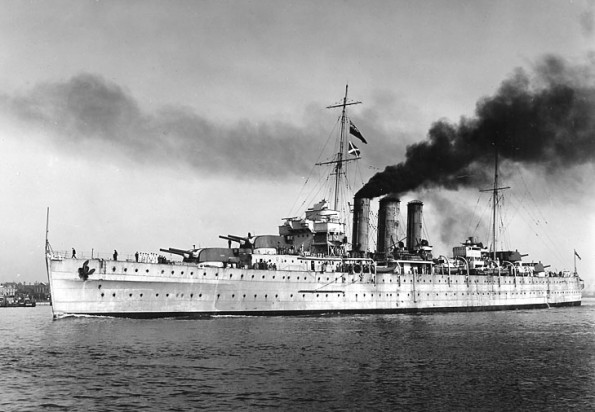
War Service:
Leading Signalman
D/JX 157442, H.M.S. Dorsetshire, Royal Navy
The account below appears in the anthology War’s Long Shadow: 69 Months of the Second World War.
The cruiser HMS Dorsetshire had assisted with the evacuation of Singapore and of Rangoon and was on patrol in the Indian ocean with HMS Cornwall.
Although Ceylon had received a warning of the approaching Japanese task force, the Royal Navy ships in the Indian Ocean were once again disadvantaged without proper air cover. The cruisers HMS Dorsetshire and HMS Cornwall were on patrol together when they came under attack from the Japanese carrier based bombers. Walter Fudge was on board HMS Dorsetshire:
At 11 a.m. Sunday 5th April, a single Japanese plane was spotted astern and at 1.40 p.m. Cornwall and we were attacked by some 80 planes. In less than ten minutes Dorsetshire was sunk and within five minutes more Cornwall went down too.
Two shipmates went down in the mess and refused to leave the ship – they were non-swimmers. At a time like that it is every man for himself. I recall seeing our new Captain Agar VC giving a salute on the fo’c’sle intending to go down with the ship; but Cassier, another shipmate would not allow that!! He bundled him over the side.
A yell from the bridge to the 4 inch AA guns crews – “Why aren’t you firing?” Reply – “All dead except me!” The masthead lookout scrambled down a rope, which had been secured there, and I was right behind him. We both smiled at the water’s edge and we exchanged words “After you!” “No, after you!!” At that time, much of the ship had gone under and only the fo’c’sle was out of water.
There was no vortex – just ear-splitting noise from the bombs (these were responsible for deafness in my right ear). The water was warm. I felt happy to have had a tot of rum earlier. We swam away and a few low flying planes machine-gunned swimmers and I found a bullet in my ankle but only under the skin – the depth of water must have slowed down its velocity.
So there we were for over 30 hours – one man taken by a shark – 1,222 officers and men from the two ships – with a total loss of 425. Tropical sun and thirst were problems but the wounded obviously had the worst time. Only one whaler boat survived and this was filled with the wounded and those badly burnt. The remainder of us clung to floating objects like Denton rafts and Carley floats.