War Service:
Sub-Lieutenant (A)
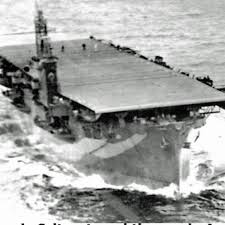
H.M.S. Dasher., Royal Naval Volunteer Reserve
*Fighter pilot with the Fleet Air Arm in the Mediterranean and on Arctic Convoys. Missing, presumed killed, March 27th 1943.
The extract below is taken from the Royal Navy Research Archive.
Catastrophic internal explosion sinks DASHER
On Saturday March 27th 1943 DASHER spent the day carrying out flying exercises. At 16:40 Captain Boswell, made an announcement over the ship’s Tannoy system that flying for the day was completed and that shore leave would be granted on arrival back at Greenock. Shortly after this there was an explosion which shook the ship, followed almost immediately by a second tremendous explosion. The officers on the bridge witnessed the ship’s two ton aircraft lift, fly about 60 feet into the air before it fell into the sea on the port side and the flight deck buckled along the length of the hanger below it.
DASHER lurched drunkenly before settling by the stern as she began to take on water. The now exposed lift shaft was belching thick black smoke and flames. The ship quickly lost head way as the engines had stopped, and all electrical power was lost. A fierce fire had broken out in the aft end of the hanger, another in the engine room, the Fleet Aim mess deck had been destroyed in the explosion and the ship was flooding fast. Men not part of the duty watch and in their mess decks were plunged into disorienting darkness were they stood. Those that could make tier way out of the ship began abandoning ship, jumping overboard from any point of exit they could reach as the fires in the hanger deck grew more intense and the ready use gun ammunition began to ‘cook off’, in addition she carried six torpedoes and 104 depth charges. By 16:48 DASHER had sunk by the stern, her flight deck almost vertical as she vanished beneath the waves 5 miles south off Cumbrae Island.
The closest vessels to the scene of the disaster were the minesweeping Trawler SIR GALAHAD, four miles to the north and the Radar Training Ship ISLE OF SARK, five miles to the south; both ships responded immediately in the knowledge that hundreds of men were swimming in the cold waters of the Clyde, many possibly injured. Other vessels were despatched from ports and harbours long the Clyde to assist. Two merchant vessels in the area at the time of the explosion, the SS CRAGSMAN and the SS LITHIUM, also made heroic rescue efforts; the CRAGSMAN rescued fourteen survivors while the LITHIUM picked up a total of sixty survivors. Burning fuel oil and aviation fuel had claimed the lives of many of those in the water, hypothermia yet others; in all 379 men out of the 528 men on board DASHER perished. 36 officers, including the C.O., and 113 ratings were rescued.
This disaster was not made public knowledge; the Admiralty deliberately put a black out on any press releases, next of kin were informed of hitter loss but the survivors were initially quarantined. The loss was promulgated in signals traffic classified as ‘most secret’, later on the 27th, and again on April 3rd. This secrecy was in part to stop the Germans learning of her loss – at his time she was one of only three ships of her kind in service with the RN, with ARCHER and BITER, a fourth AVENGER had been sunk the previous November. The first of the improved Attacker class CVEs was just about to reach the UK. And also to allow for an investigation into the cause of the explosions; enemy action was quickly discounted so the real cause had to be found. The suggestion that she had been sunk was raised in the U.S. three weeks later, a crew member had been incompact with a friend in New York mentioning casualties by name. It is not clear when, or if the news of the loss of DASHER was released.
A board of enquiry was quickly assembled and this convened on-board DASHER’s sister ship ARCHER on the morning of Tuesday March 30th. Twenty six survivors were also present on ARCHER to give evidence. The 5 board members toured ARCHER’s hangar, engine room, petrol stowage and petrol control room, as well as the add Depth Charge Magazines. After two days of hearing evidence the board departed ARCHER. The enquiry established that the initial explosion was caused by the ignition of petrol probably due to a cigarette or faulty light switch; at this time all 6 Swordfish and 2 Sea Hurricanes were in the hangar, 2 Swordfish were being refuelled, 1 Sea Hurricane remained on the flight deck the Petrol control Room was open and manned for fuelling aircraft, ‘No Smoking’ signs were correctly displayed but no sentry was posted. Evidence of petrol leakage into inaccessible and unsafe areas was given and it was established that access hatches to the FAA mess and engine room shaft tunnel were open. They concluded that the initial explosion occurred in either the Petrol stowage area or the aft Depth Charge Magazine (containing 68 Depth Charges) which ware adjacent to each other and was caused by a build-up of petrol vapour. [It is assumed, but not stated, that the second explosion was the petrol stowage tanks themselves going up; she carried up 85,000 gallons of aviation petrol.